
Living independently at home is the ultimate goal for most seniors. However, as the years pass, simple tasks that once felt like second nature—buttoning a favorite sweater, reaching for a coffee mug, or stepping into a bathtub—can become frustrating or even dangerous obstacles.
This loss of independence doesn’t just affect physical health; it chips away at a person’s dignity and mental well-being. The constant fear of a fall or the exhaustion of struggling through a daily routine can lead many families to believe that a care facility is the only remaining option.
But there is a bridge between struggling at home and moving away from it. Occupational therapy (OT) in home care is the secret weapon that empowers seniors to reclaim their environment. By focusing on the jobs of daily living, OT provides the tools, strategies, and modifications necessary to live safely and joyfully in one’s own home.
Many people hear the word occupational and assume the therapy is related to returning to a job. In the world of senior care, your occupation is simply the way you occupy your time. It is the art and science of helping people do the things they want and need to do through the therapeutic use of daily activities.
When delivered in a home care setting, OT is uniquely effective. Instead of practicing skills in a clinical gym, the therapist works with the seniors in their actual kitchen, bathroom, and bedroom. This real-world application ensures that every intervention is practical and immediately useful.
The American Occupational Therapy Association (AOTA) emphasizes that OT practitioners enable people of all ages to live life to its fullest by helping them promote health and prevent—or live better with—injury, illness, or disability.
Before any exercises begin or equipment is ordered, an Occupational Therapist (OT) performs a deep-dive evaluation. This isn’t just a medical check-up; it’s a holistic look at the person’s life.
The therapist observes how the senior moves. They look at range of motion, strength, balance, and coordination. They don’t just ask, “Can you walk?” They ask, “Can you walk while carrying a laundry basket?”
Home safety requires more than physical strength; it requires executive functioning. The OT assesses memory, problem-solving skills, and the ability to follow multi-step instructions—all critical for tasks like managing medications or cooking.
This is where the OT acts as a home detective. They look for hidden hazards that the family might have stopped noticing, such as:
Once your audit is complete, it’s time to take action. These modifications range from simple DIY fixes to professional installations.
Do not settle for suction cup grab bars; they are prone to failing. Ensure all bars are securely anchored into wall studs.
Rugs are the silent enemy of senior safety. Even if they look beautiful, a curled edge can lead to a devastating hip fracture.
The safest move is to remove all area rugs and keep hard flooring or low-pile carpeting. If a rug must stay, use heavy-duty double-sided tape or a non-slip rubber backing to keep it flush with the floor.
Standard 60-watt bulbs often aren’t enough for aging eyes. Swap them for bright LED bulbs that mimic natural daylight.
Consider adding nightlights with light sensors in every hallway and bathroom. A well-lit path at 2:00 AM can be the difference between a safe night and a trip to the ER. The National Institute on Aging emphasizes that proper lighting is one of the easiest ways to prevent falls.
Wet feet and smooth tubs don’t mix. Apply non-slip adhesive strips or high-quality rubber mats to the floor of the shower and bathtub.
In the kitchen, consider a comfort mat near the sink. These provide extra traction and reduce leg fatigue for seniors who enjoy cooking.
At the heart of geriatric occupational therapy is the mastery of daily tasks. These are generally categorized into two groups: ADLs and IADLs.
ADLs are the fundamental skills required to care for oneself. When a senior struggles with these, their health and hygiene can decline rapidly. OTs provide specialized training in:
IADLs are more complex tasks that allow a senior to function within a community and home. These include:

According to the National Institute on Aging (NIA), more than one in four people age 65 or older fall each year. Falls are the leading cause of injury-related ER visits for seniors.
Occupational therapy in home care is one of the most effective ways to reduce this risk. An OT doesn’t just tell a senior to be careful. They implement a multi-faceted fall prevention strategy:
Sometimes, the problem isn’t the person—it’s the house. Most homes were not built for people with mobility challenges. An OT identifies the necessary home modifications to bridge this gap.
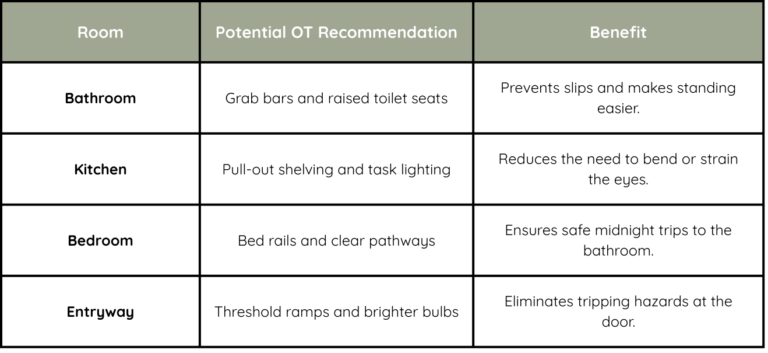
By making these changes, the home evolves from a place of risk to a sanctuary of safety.
Occupational therapy is a powerhouse for seniors living with Dementia or Alzheimer’s. When memory begins to fade, the environment must become more intuitive.
OTs use cognitive rehabilitation techniques to help seniors maintain their brain power for as long as possible. This includes:
The goal is to focus on the abilities that remain, rather than focusing solely on what has been lost.
Occupational therapy does not exist in a vacuum. For the best outcomes, it must be part of a collaborative effort involving the senior, their family, and their home care agency.
A high-quality care plan often involves:
One of the most overlooked roles of an OT is caregiver education. Family members often experience burnout or injury from trying to lift or assist their loved ones incorrectly. The OT teaches caregivers body mechanics—the safe way to assist a senior without straining their own back or neck.
While there is a clear financial benefit to OT—it is often much more affordable than a fall-related hip surgery or a move to assisted living—the real return on investment is emotional.
When a senior can once again make their own tea or walk to the mailbox safely, they regain a sense of self-efficacy. This independence is the cornerstone of mental health in aging. It reduces the feeling of being a burden and replaces it with the pride of self-reliance.
Occupational therapy in home care is more than just a medical service; it is a pathway to a better life. By addressing the physical, cognitive, and environmental factors that hinder daily living, OTs provide a comprehensive solution for families who want the best for their aging loved ones.
If you are noticing that a loved one is struggling with their daily routine, don’t wait for a crisis or a fall to occur. Proactive intervention is the key to successful aging in place.
Ready to transform your home into a safe haven of independence? Our team of specialists is dedicated to helping seniors thrive where they are most comfortable—at home.
Contact us today for a personalized consultation and see how occupational therapy can change your life!